AI search is changing how buyers find and evaluate companies. If your brand is not showing up in AI generated answers from ChatGPT, Perplexity, Gemini, Claude, or Google AI Overviews, you are already losing ground to competitors who are.
This guide breaks down the practical steps you can take to improve your company’s AI search discoverability, from entity cleanup and content strategy to technical foundations and measurement.
Key Takeaways
- AI search discoverability is about how often and how accurately your brand appears in AI generated answers across tools like ChatGPT, Gemini, Claude, Perplexity, and Google AI Overviews. AI visibility measures how often your brand is cited in AI answers, not just how many blue links you rank for.
- AI search optimization is a layer on top of existing SEO, PR, and content strategies. It is not a replacement. The main AI engines and answer engines to care about include ChatGPT, Gemini, Perplexity, Claude, Google AI Mode, and Copilot.
- Three levers matter most for AI search visibility: consistent entities and brand identity, authoritative and citation-worthy content, and strong external trust signals like reviews, PR coverage, analyst reports, and social proof.
- Brands should measure AI visibility directly by tracking share of AI results where the brand appears, recommendation rate, and citation rate across AI tools, rather than relying only on organic traffic and keyword rankings.
- 90% of businesses worry about decreasing online visibility due to AI, and AI search is expected to surpass traditional search by early 2028. Acting now gives you a head start.
The sections below walk through definitions, technical fundamentals, content strategies, and a phased roadmap you can execute over the next 6 to 12 months.
1. Define AI Search Discoverability And Why It Matters In 2026
AI search discoverability refers to the extent your company is included, accurately represented, and confidently recommended in AI generated responses from large language models and AI powered search tools. Unlike traditional search engines that return a list of blue links, AI search engines synthesize information from multiple sources into direct answers, summaries, and recommendations.
By late 2026, AI search results surfaced across Google AI Overviews, ChatGPT Search, Perplexity, Gemini, and Claude. These tools influence both B2B and B2C purchase journeys before buyers ever speak to a sales team or click through to your website. Nearly 60% of mobile Google searches now end without a click, and projections suggest organic traffic could drop by over 50% by 2028 as AI summaries absorb more of the discovery process.
Here is how AI search discoverability differs from traditional SEO:
- Traditional SEO focuses on ranking pages among search engine results pages. AI search optimization focuses on whether your brand appears, gets quoted, or gets recommended inside AI generated summaries.
- AI answers quote at the paragraph or sentence level. Your content needs to be structured so relevant facts, data points, and definitions are easy for AI models to extract.
- AI engines evaluate trust systems beyond just keyword matching for content discoverability. Entity graphs, brand authority, and external trust signals all play a role.
Despite the shift, AI-driven search referrals currently account for just 1% of traffic. Fewer than 1% of website traffic currently comes from AI search referrals. But that number is growing fast, and the companies investing now are the ones shaping how AI tools describe their category.
For high-intent prompts like “best project management tool for remote SMBs in 2026” or “top CRM platform comparison,” being named in AI answers dramatically increases consideration and brand perception.
2. Understand How AI Search Engines And Answer Engines Work
To improve your visibility in AI search, you need to understand how AI search engines work under the hood.
Most modern AI answer engines use retrieval-augmented generation (RAG). When a user submits a prompt, the system first retrieves relevant documents and web content, then generates an answer using both the retrieved material and the underlying language model. If your content is not findable or retrievable, it simply cannot be used.
AI systems build entity graphs (also called knowledge graphs) around companies, products, people, and categories. These internal maps help AI platforms decide what to recommend for a given query. Clear, consistent entity signals strongly affect AI search visibility.
The classic search flow is “query leads to a list of links.” The AI answer engine flow is “query leads to synthesis leads to an AI answer with cited sources.” AI search prioritizes conversational context over traditional keyword matching. About 30% of ChatGPT prompts fit traditional search intent categories, which means AI tools are handling a new type of user intent that blends natural language processing with evaluation-stage research.
On average, AI systems pull information from an average of 9 to 15 sources per answer, though this varies significantly by platform.
AI crawlers and bots: Different AI engines use different crawlers. GPTBot serves ChatGPT, PerplexityBot serves Perplexity, ClaudeBot serves Claude, and Google uses its own extended bots. Each has its own crawl rules and cadence. If your robots.txt blocks these bots, your content will not appear in their AI results.
3. Key AI Search Platforms And How They Display Brands
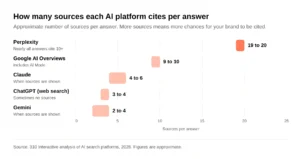
Understanding how each AI platform handles citations and sources is foundational for AI search optimization. The table below summarizes the behavior of the major AI search platforms as of mid-2026.
| Platform |
Answer Style |
Citation Visibility |
Typical Number of Sources per Answer |
| Perplexity |
Long-form synthesized summaries with quoted facts and comparisons |
High; citations shown prominently inline or after answer |
Approximately 19 to 20 sources; nearly 100% of answers include 10+ sources |
| Google AI Mode / AI Overviews |
Synthesized overview paragraphs drawn from top organic results |
Often shows domain names and links; sometimes limited to top 10 domains |
Approximately 9 to 10 sources depending on vertical |
| ChatGPT (with web search) |
Conversational answers with mixed depth depending on prompt |
Moderate; typically shows 1 to 4 sources, sometimes none if relying on model memory |
Approximately 3 to 4 sources per answer on average |
| Gemini |
Balanced conversational and factual answers, sometimes visually formatted lists |
Low to moderate; many answers have no citation |
Approximately 2 to 4 when citations are present |
| Claude |
Narrative, explanation-driven answers with qualifiers and trade-offs |
Moderate; citations shown but not always; source selection is conservative |
Approximately 4 to 6 sources when citations are present |
These differences should shape which platforms you prioritize based on your audience. A B2B company whose buyers use Perplexity for research will benefit from a different citation strategy than one whose audience relies on Google AI Overviews.
4. Clarify Your Company’s Entity, Category, And Positioning
AI systems rely on consistent entity and category signals to decide where your brand shows up in AI search results. If your company name, product names, industries served, or founding year differ across platforms, AI models may split your entity or misclassify your brand entirely. Establish entity clarity by keeping branding details consistent across platforms.
- Standardize how you describe your company across your homepage, product pages, About page, LinkedIn, Crunchbase, G2, Capterra, and other key profiles. Use one canonical “elevator pitch” paragraph everywhere.
- Explicitly state your primary category on core pages. A weak example: “analytics software.” A strong example: “B2B revenue intelligence platform for mid-market SaaS companies to optimize forecasting and pipeline accuracy.” This clarity helps AI interpret your relevance to specific prompts.
- List supporting subcategories including industries served (fintech, healthcare, ecommerce), use cases (revenue forecasting, sales analytics), and target customer segments.
- Create an internal “entity sheet” that documents official brand names, product line names, leadership names, headquarters city and country, and target customer segments. Distribute this to content, SEO, PR, and product marketing teams.
This entity sheet ensures that every blog post, press release, and product page reinforces the same identity to AI systems.
5. Create Content That Matches AI Buyer Journeys (Comparison, Evaluation, And Decision)
To create content that improves AI search discoverability, start by mapping the prompts and questions your prospects actually type into AI tools. Common patterns include:
- “Best [category] software for [audience]”
- “[Competitor] alternatives for [use case]”
- “[Tool A] vs [Tool B]”
- “[Category] pricing for startups in 2026”
- “Is [category] worth it in 2026”
Focus on creating content that genuinely addresses user questions across these buyer journey stages. Content should answer complex natural-language queries to align with conversational search engines and conversational language patterns.
Content types that support AI search optimization include detailed comparison pages, feature-by-feature tables, pricing explainers, ROI calculators, and objection-handling guides. AI engines often favor neutral, balanced comparison content over purely promotional messaging. Include honest tradeoffs, strengths, and weaknesses. Using natural language improves AI content optimization more than keyword-stuffed copy.
Publish at least one in-depth buyer’s guide and one “alternatives to [competitor]” piece per core product line, with up-to-date data and clear dates (for example, “updated September 2026”).
6. Example Bottom-of-Funnel Assets That Improve AI Search Discoverability
The assets below are what AI systems commonly quote when crafting conversational answers during evaluation or decision stages. Each asset type maps to specific user behavior and AI intents.
| Asset Type |
Sample Title |
Target AI Query |
AI Visibility Goal |
| Competitor comparison page |
“CRM Platform A vs CRM Platform B: Full 2026 Comparison” |
“best CRM for B2B fintech 2026” |
Be cited when prospects compare tools |
| Alternatives article |
“Top 7 Alternatives to [Competitor] for Mid-Market Teams” |
“alternatives to [Competitor] for [use case]” |
Win inclusion in AI answers mentioning competitors |
| Pricing page / pricing breakdown |
“Marketing Analytics Pricing Guide for Startups (2026)” |
“marketing analytics pricing for small business 2026” |
Be used as evidence in cost-related AI answers |
| Customer case study |
“How [Fintech Company] Increased Pipeline Accuracy by 42%” |
“how fintech companies improve sales forecasting” |
Provide real metrics AI can quote to build trust |
| Implementation guide |
“How to Implement Revenue Intelligence in 30 Days” |
“how to implement revenue intelligence solution” |
Earn visibility in action-oriented queries |
Each of these assets serves as structured content that AI tools can confidently extract and present as part of AI generated summaries.
7. Use Structured Data And Technical Foundations To Help AI Systems Read Your Site
AI search engines heavily rely on structured data and clean HTML structure to understand entities, products, FAQs, and organization details. Structured data helps AI understand your content better, and schema markup increases the likelihood of being cited by AI.
- Implement Organization, Product, FAQ, Article, and HowTo schema markup where relevant. The structured data must exactly match visible content to avoid confusion or loss of trust from AI crawlers.
- Optimize site performance and ensure clean information architecture for better AI crawlability. Aim for a time to first byte (TTFB) under 200 ms and total page load under 2 seconds.
- Maintain strict technical SEO standards to ensure pages are crawlable and indexable. Avoid hiding critical content behind JavaScript-only rendering or lazy-load scripts that AI bots cannot execute.
- Keep documents easily retrievable for AI systems by ensuring proper technical setup. Audit your robots.txt and meta tags to confirm that GPTBot, ClaudeBot, PerplexityBot, and Google’s crawlers can access product pages, pricing information, documentation, and proof pages.
- Use server-side rendering for key sections that contain product names, features, and pricing data. This is a straightforward technical SEO improvement that directly supports AI discovery.
8. Strengthen Brand Authority And Third-Party Trust Signals
AI models prioritize credible, authoritative sources for citations, and brands without authority risk being excluded from AI generated answers entirely. AI search engines rely on digital reputation and corroboration with credible third-party sources to decide which brands to recommend.
- E-E-A-T signals are crucial for establishing brand authority online. Secure coverage in industry publications, analyst reports, and inclusion in “best of” lists. Plan a focused PR calendar aimed at securing a small number of high-authority mentions per quarter.
- Cultivate positive mentions and reviews on high-authority platforms to enhance brand authority. Use post-onboarding email flows, in-app prompts, and customer success programs to collect authentic reviews on review sites like G2, Capterra, and Trustpilot.
- Quality backlinks enhance brand authority in AI search results. Prioritize backlinks from credible publications over volume-based link building.
- Spotlight third-party proofs on your site with quotes, logos, and links so AI tools can easily associate your brand with credible validators.
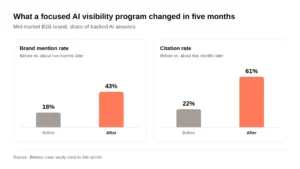
In a documented case study, a mid-market company improved its brand mention rate in AI answers from 18% to 43% over approximately five months and improved its citation rate from 22% to 61%. The primary drivers were entity signal rebuilding, authoritative content creation, and trust signal improvement.
9. Make Your Content Citation-Worthy For AI Results
Creating citation-worthy content is key to both AI search optimization and answer engine optimization. AI tools prefer content that is clear, specific, sourced, and recent. AI models prefer clear, structured, and authoritative content.
- Write concise answer paragraphs (40 to 80 words) for key questions at the top of pages, then expand with deeper sections. This helps AI systems easily extract useful snippets for AI generated responses. Ensure text formatting is clear and concise to aid AI system comprehension.
- Optimize content into short self-contained sections to improve visibility in AI models. Add data tables, bullet lists, and step-by-step instructions that both humans and AI engines find easier to parse.
- Publish proprietary research and original data sets to be cited as primary sources by AI tools. Include concrete data points and dates (for example, “survey conducted in Q1 2026”) with explicit attributions to original research.
- Include customer quotes and hard metrics, such as “reduced onboarding time by 37% in 6 months” or “increased revenue per user by 22%.” These real-world examples act as mini case studies AI tools can safely reuse.
- Content should be updated regularly to maintain AI visibility. Add “last updated” timestamps to all key content pieces. E-E-A-T signals are vital for content credibility in AI search.
As TechRadar has noted, AI search is shifting brand visibility from keyword ranking toward data verification and provenance signals. Content quality matters more than content volume.
10. Align Your Site Architecture And Internal Links With AI Topics
Group content into clear topic clusters around your main categories, use cases, and industries so AI engines can infer your strongest areas of expertise and associate your brand with those themes.
- Create pillar pages (category overviews) that internally link to detailed guides, comparison content, FAQs, and case studies. This makes it easy for AI crawlers to follow and map relationships between your pages.
- Use clear navigation labels, descriptive menus, and consistent category labels in headers and footers. These signals help AI systems understand what your company should be known for in AI search.
- Tag or segment blog posts by audience type, industry, and job role. Use those tags to build hub pages that can rank and be cited as definitive resources.
Here is a concrete example. Suppose your company sells an AI-powered marketing analytics platform. Your pillar page might be “Marketing Analytics Platform Overview,” which links to “Marketing Analytics vs Customer Insights Tools,” “How to Choose a Marketing Analytics Platform for B2B SaaS,” “Marketing Analytics Pricing Guide (2026),” and case studies like “Marketing Analytics in Fintech” and “Marketing Analytics in Ecommerce.”
This cluster approach tells AI engines that your brand shows deep expertise in marketing analytics, making it more likely to appear when someone asks an AI tool for recommendations in that category.
11. Monitor AI Search Visibility And Compare Against Competitors
Traditional SEO metrics like organic traffic, impressions from Google Analytics, and keyword rankings do not fully reflect performance in AI search results. Marketers must track AI-related metrics for visibility in AI results. AI visibility success includes how often AI tools recommend your brand, and AI search optimization requires measuring brand perception in AI answers.
- Run a fixed list of 25 to 50 strategic prompts in ChatGPT, Perplexity, Gemini, and Claude every month. Log which brand appears, gets cited, or gets recommended as a top choice. Monitor AI-generated mentions to understand how your business is being described.
- Use analytics and log files to identify AI-related referrers and bot names, then correlate changes in AI traffic with content updates, PR wins, and technical fixes.
- Build a recurring “AI visibility scorecard” that combines prompt coverage, citation count, sentiment of brand mentions, and estimated revenue influence. Review it at least quarterly.
- Measure AI citations to track brand visibility beyond traditional SEO metrics. AI visibility measures brand representation in AI generated answers, giving you a much clearer picture of how your online visibility is evolving.
According to research from Cloro, there is a trend toward fewer sources per answer across many engines in 2026. ChatGPT dropped from approximately 21 sources per answer in March to about 12 in June. This means the competition for citation slots is intensifying, and the brands that invest in authoritative content and trust signals will capture a disproportionate share.
Your Brand Vs Competitors In AI Search Visibility
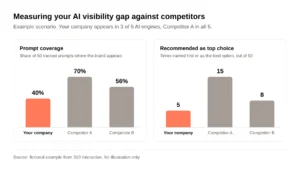
The following example scenario illustrates how you might quantify gaps in AI search visibility against competitors. These are fictional values for illustration purposes.
| Brand |
Prompts Where Brand Appears (Out of 50) |
Times Recommended as Top Choice |
Number of AI Engines Where Brand Is Visible |
| Your Company |
20 |
5 |
3 |
| Competitor A |
35 |
15 |
5 |
| Competitor B |
28 |
8 |
4 |
A marketing team could use a snapshot like this to identify exactly where they are losing to Competitor A and prioritize content creation, PR outreach, and technical improvements for the prompts where their brand is absent. This is just what separates companies with strong AI discovery from those being overlooked.
Traditional SEO Metrics Vs AI Search Visibility Metrics
Mature companies should track both traditional and AI visibility metrics to understand full-funnel discoverability. Traditional SEO focuses on traffic and rankings; AI metrics focus on citations, recommendations, and brand perception in AI generated answers.
| Metric Type |
Example Metric |
What It Tells You |
When It Is Most Useful |
| Traditional SEO |
Organic Sessions |
Volume of visits via search engine links |
Measuring reach and traffic trends in SERPs |
| Traditional SEO |
Keyword Rankings (Top 10) |
Visibility for specific queries in link lists |
Optimizing content for traditional search engines |
| Traditional SEO |
Search Console Impressions |
How often URLs appear in search results |
Strategy planning and understanding category reach |
| AI Search Visibility |
Share of AI Answers with Brand Mention |
How often your brand appears in AI responses |
Measuring presence in AI-driven discovery channels |
| AI Search Visibility |
Citation Rate in AI Answers |
How often AI answers link or reference your domain |
Tracking trust and attribution from AI platforms |
| AI Search Visibility |
Recommendation Rate |
How often your brand is named first or as best option |
Understanding competitive wins in AI results |
| AI Search Visibility |
Prompt Coverage |
Proportion of target prompts where brand appears |
Identifying content gaps and planning priorities |
Both metric sets complement each other. SEO best practices drive traffic; AI visibility metrics reveal whether your brand’s visibility in AI search is translating into buyer awareness and customer satisfaction before they ever visit your site.
Operationalize AI Search Optimization Inside Your Company
Improving AI search discoverability requires cross-functional collaboration across SEO, content, PR, product marketing, and data teams. This is not a side project owned by one person.
- Assign a specific owner or small working group responsible for AI visibility. Set quarterly goals such as “increase citations in AI results by 25%” or “double the number of prompts where our brand is recommended.”
- Fold AI search optimization into existing workflows. Content briefs should include target AI prompts. PR pitches should be timed with major content launches. Technical sprints should prioritize AI crawler access and schema markup rollout.
- Schedule monthly reviews where the team tests real prompts in AI tools, examines how the company is described in AI generated responses, and quickly corrects inaccuracies at the source, whether that is site content, external profiles, or documentation.
- Align these efforts with generative engine optimization and answer engine optimization goals. Generative AI is reshaping how buyers discover brands, and your internal processes need to reflect that shift.
Think of this as similar to how you might operationalize Google Ads or meta descriptions optimization: dedicated owners, clear metrics, and integration into the broader marketing calendar.
Roadmap For Improving AI Search Discoverability Over 6 to 12 Months
30-day foundation phase:
- Audit all entity signals (brand name, product names, About page, profiles) for consistency across platforms
- Run a technical audit to confirm AI crawlers have access, structured data is in place, and page speed is acceptable
- Establish a baseline by running 25 to 50 target prompts across ChatGPT, Perplexity, Gemini, and Claude. Record current brand appearance, citation, and recommendation rates
90-day build phase:
- Produce high-value comparison and alternatives content, buyer guides, and pricing explainers
- Implement or expand schema (FAQ, HowTo, Product, Organization) across key pages
- Execute PR outreach to secure authoritative mentions and drive review collection
- Restructure existing content for answer-readiness with short answer paragraphs and data tables
Ongoing optimization:
- Update content regularly to maintain freshness signals for AI visibility
- Monitor prompt panels monthly and review the AI visibility scorecard quarterly
- Iterate on site architecture and topic clusters based on which prompts are underperforming
Here is a mini timeline: A mid-sized B2B company starts in January 2027 with entity cleanup and baseline prompt measurement. In February and March, they build three new comparison pages and Organization schema. In April, they launch a targeted PR campaign and begin collecting reviews. By June, they review prompt performance and find that prompt coverage has increased from 22% to 38% across four AI engines. In Q3, they double down on the content themes that showed the strongest gains and scale the approach.
Early fixes compound. Every entity cleanup, every schema improvement, every piece of authoritative content makes the next piece more likely to appear in AI search results.
Frequently Asked Questions About AI Search Discoverability
How long does it usually take to see improvements in AI search visibility?
Small improvements, such as better brand descriptions in AI tools, can appear within 4 to 8 weeks after entity cleanup and technical fixes. More substantial shifts in recommendation frequency and citation rate typically take 3 to 9 months of consistent content, authority building, and measurement work. The key is consistency. One-off fixes rarely produce lasting results.
Can a smaller company realistically compete with large brands in AI search results?
Yes. Smaller companies can win in specific niches and high-intent prompts by being more focused. Publishing deeper, fresher resources on narrow topics, collecting strong reviews, and securing a few authoritative mentions can outperform enterprise-scale content libraries in targeted AI answers. You do not need to dominate every category, just the ones where your ideal buyers are searching.
Do we need special AI tools to improve AI search discoverability?
While specialized AI visibility platforms can help with prompt-level tracking and competitive insights, teams can start with manual testing in popular AI engines, updates to technical SEO, structured data improvements, and targeted PR before investing in additional software. The initial effort often yields strong ROI without new tools.
Is AI search optimization the same as answer engine optimization (AEO) or generative engine optimization (GEO)?
AI search optimization, AEO, and GEO all focus on making brands more discoverable and recommendable in AI generated answers. This article uses “AI search discoverability” as an umbrella concept that includes technical access, content strategy, entity clarity, and authority building. It is broader than just optimizing for specific answer boxes or a single AI platform.
What is the biggest mistake companies make with AI search discoverability?
The most common misstep is treating AI search as an afterthought. Companies rely only on existing SEO content without auditing brand consistency, authority signals, or how AI tools actually describe them. This leads to missed opportunities and sometimes inaccurate AI results that damage brand perception. A proactive approach, starting with entity audits and prompt monitoring, prevents these problems from compounding.