Introduction: The 10 B2B Web Design Agencies You Should Shortlist First
B2B web design in 2026 looks nothing like it did five years ago. Buyers now research solutions independently, often engaging multiple stakeholders before a single sales conversation happens.
With longer sales cycles, complex products, and AI-driven research reshaping how prospects evaluate vendors, your website is the first (and sometimes only) impression that matters. B2B web design must be tailored for long sales cycles and complex products, which means picking the wrong partner can cost you pipeline, not just pixels.
Too many agencies still prioritize aesthetics over functionality in B2B design. A beautiful site that confuses buyers or buries the demo request form is a liability, not an asset. Choosing agencies without B2B experience risks misaligned strategies that ignore conversion paths, multi-persona navigation, and the technical integrations your revenue team depends on.
Here are the 10 agencies featured in this guide:
- 310 Interactive
- Bop Design
- Huemor
- Webstacks
- Clay
- Lform Design
- Ironpaper
- UPQODE
- Phenomenon Studio
- Lounge Lizard
These agencies were selected for their B2B specialization, measurable results, integration capabilities, and design quality. The article compares them across industries, company sizes, and tech stacks so you can narrow your options fast.
How We Chose The Best B2B Web Design Agencies
Research was based on portfolios, published case studies, and public data from platforms like Clutch, partner directories, and agency press releases. Only agencies with clear B2B case studies and named client outcomes (percentage lift in leads, revenue, speed) made the cut.
Agencies are frequently shortlisted based on specialization and technical capabilities. Here are the criteria we used:
- Conversion architecture: Does the agency design clear paths for lead generation, demo requests, and buyer qualification?
- Buyer-journey understanding: Buyer journey mapping is crucial for B2B web design. We looked for agencies that map multiple decision-makers and buying stages into site structure.
- Platform and integration depth: CRM, marketing automation, ERP, and ABM tool integration capabilities.
- Technical performance: Site speed, mobile responsiveness, accessibility, and modern development practices.
- UX/UI quality: Visual design, brand expression, and intuitive interfaces for complex products.
- Post-launch support: Ongoing optimization, analytics, and structured conversion rate optimization programs.
A clear understanding of buyer personas is crucial for B2B agencies, and every agency on this list demonstrated that in their work. This list is not pay-to-play. Agencies cover a mix of budgets and project sizes.
Evaluation Criteria & Weighting
This table shows how each criterion influenced the rankings. B2B web design must prioritize conversion architecture for effectiveness, which is why it carries the heaviest weight.
| Criterion | Description | Weight (Out of 100) |
| Conversion Architecture | Lead gen paths, buyer journey mapping, demo/RFQ flow design | 25 |
| B2B Specialization & Vertical Fit | Industry experience, complex buyer profiles, deep expertise in B2B | 20 |
| Platform & Integration Depth | Headless CMS, CRM, MAP, ERP, ABM tool compatibility | 20 |
| UX/UI Design Quality & Brand Expression | Visual identity, design cohesion, brand strategy, interactive polish | 15 |
| Proof of Results | Named case studies with quantitative data on leads, traffic, conversion | 10 |
| Post-Launch Support & Optimization | Ongoing maintenance, CRO, content updates, technical support | 10 |
- B2B web design agencies focus on conversion architecture because complex buyer journeys demand more than visual flair alone.
- Platform and integration depth matters more now with composable tech, automation, and AI-assisted personalization becoming standard.
- Post-launch support includes ongoing optimization for better performance, which is why it remains a scored factor even at 10%.
The 10 Best B2B Web Design Agencies To Consider
All 10 agencies excel at B2B web design but fit different niches. Some specialize in manufacturing, others in SaaS, enterprise, or mid-market firms. Top B2B web design agencies are specialized by industry and project type, and many focus on user-friendly, conversion-focused websites. Each profile below includes an agency overview, approach, and pros/cons so you can compare quickly.
1. 310 Interactive
Best For Mid-Market B2B Lead-Generation Websites
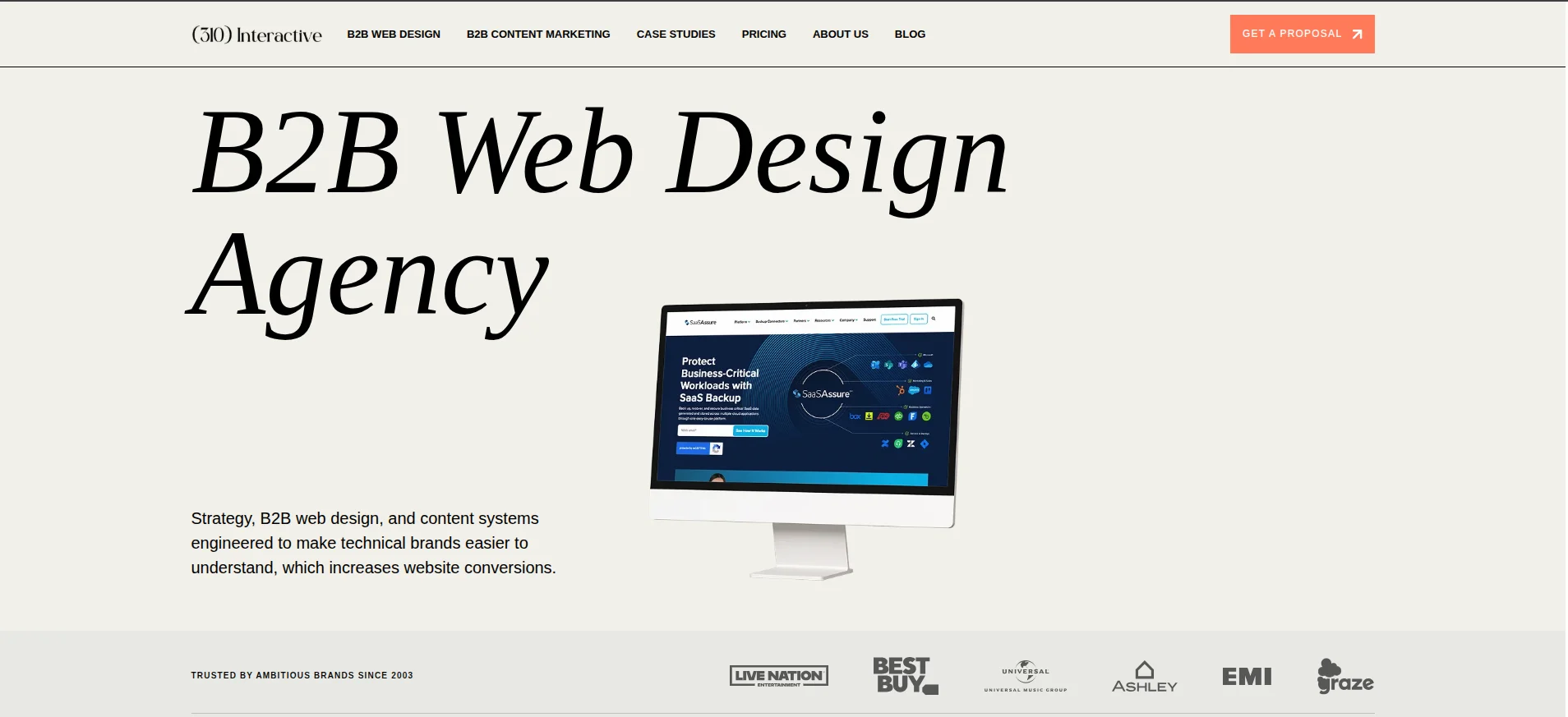
A full-service B2B web design agency known for custom web design and analytics-driven optimization. They serve both B2B and B2C clients with a strong emphasis on measurable business outcomes.
Agency Overview
- Founded in 2013. Headquartered in Los Angeles, CA
- Small to mid-sized team focused exclusively on B2B
- Key B2B sectors: technology companies, industrial, professional services, manufacturing
- Notable clients include Live Nation, Best Buy, EMI, HammerTech
- A 2025 website relaunch for SnoopDogg.com case study produced a 4x increase in page views, 15x increase in active users, and 8x rise in engaged sessions
Agency Approach To B2B Web Design
Their approach begins with a deep understanding of your business objectives, target audiences, buyer journeys, and competitive landscape. By aligning executive stakeholders, marketing teams, and sales priorities from the outset, they establish a clear foundation for success. They combine strategic positioning, compelling messaging, intuitive user experiences, and conversion-focused content to create websites that build trust, simplify complex buying decisions, and accelerate pipeline growth.
From information architecture and responsive design to CMS development, SEO, analytics, accessibility, and marketing technology integrations, every element is engineered to support measurable business outcomes. Through transparent collaboration, clearly defined milestones, and continuous optimization, we reduce project risk while delivering scalable, high-performing digital experiences. The result is more than a redesigned website: it’s a revenue-focused digital platform built to improve search visibility, increase conversion rates, empower sales teams, and support long-term business growth.
Pros
- Proven track record with complex SaaS and Tech sites
- Strong analytics practice producing 40%+ uplift in qualified leads
- Combines comprehensive digital strategies covering design, content, SEO, and performance
- Deep understanding of industrial and enterprise brands with legacy site challenges
Cons
- Higher minimum budgets suited to mid-market level engagements
- Longer timelines due to scope complexity
- Less suited for very small B2B firms needing a lean marketing site
- Potentially heavier client internal bureaucracy on large projects
2. Bop Design
Best For Enterprise-Grade B2B Websites With Measurable Growth
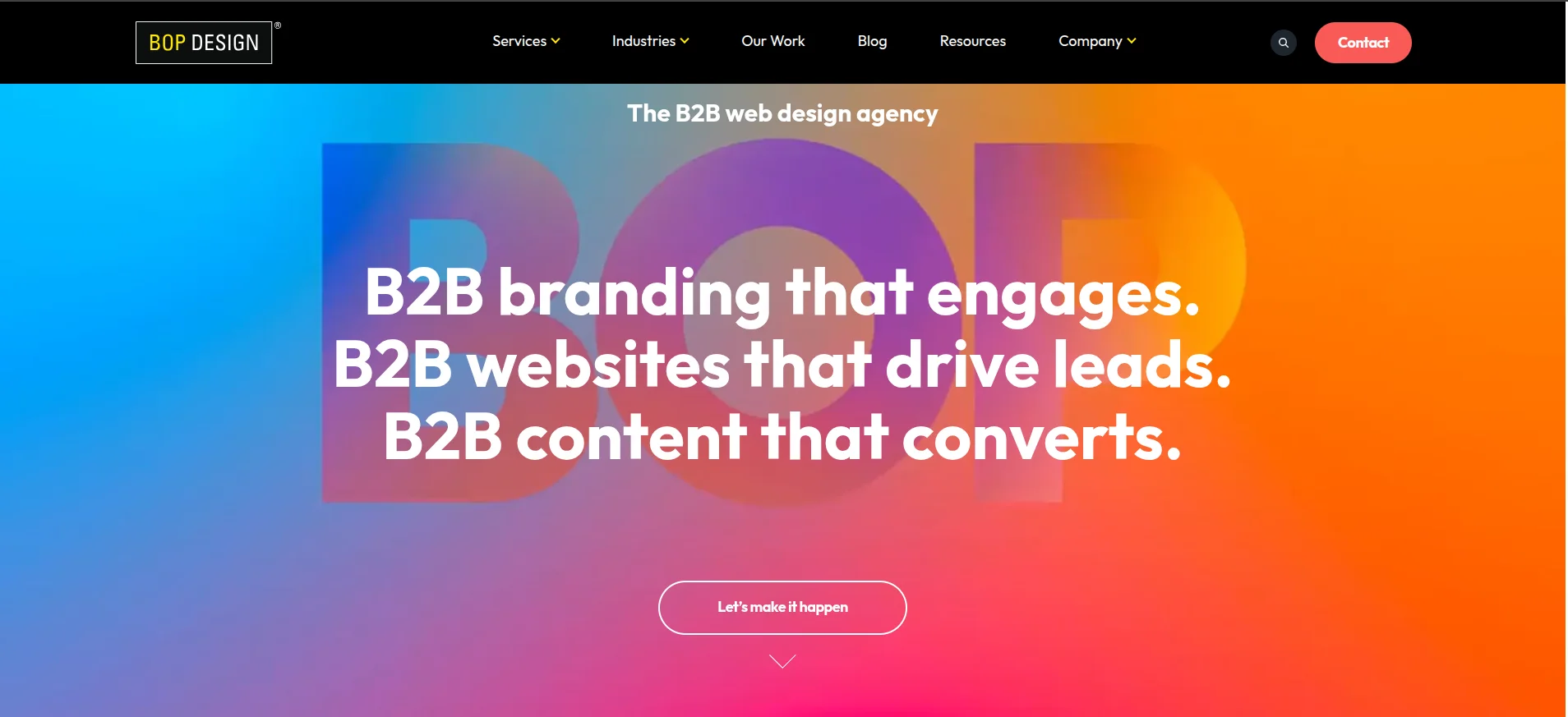
Bop Design is a B2B-only web design agency focused on marketing websites that feed sales pipelines for small to mid-sized firms.
Agency Overview
- Founded around 2008, with offices in San Diego, Orange County, and New York
- Team scale supports large, multi-region enterprise clients
- Core sectors: industrial, consulting, logistics, software, and investment firms
- The Brixton Capital case study (launched January 2025) showed +57% sessions, +49% organic search sessions, and +54% event counts after a full redesign
Agency Approach To B2B Web Design
Bop Design emphasizes positioning, messaging, and content strategy before design begins. For Brixton Capital, they expanded the site from 5 pages to 40+, adding leadership profiles, ESG sections, and interactive portfolio maps.
Their platform of choice is typically WordPress, with navigation structured for multiple buyer personas. They integrate email marketing, basic marketing automation, and SEO-focused content planning. Their approach to web design services centers on strategic thinking and content-first architecture.
Pros
- Deep B2B specialization with strong copy and content strategy
- Good fit for companies under 250 employees looking for lead generation
- Content expansion approach drives organic traffic growth
- Accessible budgets compared to enterprise-tier agencies
Cons
- Limited fit for transactional commerce sites or self-service portals
- Scale limitations when managing many large content builds simultaneously
- Visual design sophistication may trail boutique high-craft studios
- Less advanced on complex platform integrations
3. Huemor
Best For Conversion-Driven B2B Brand Experiences
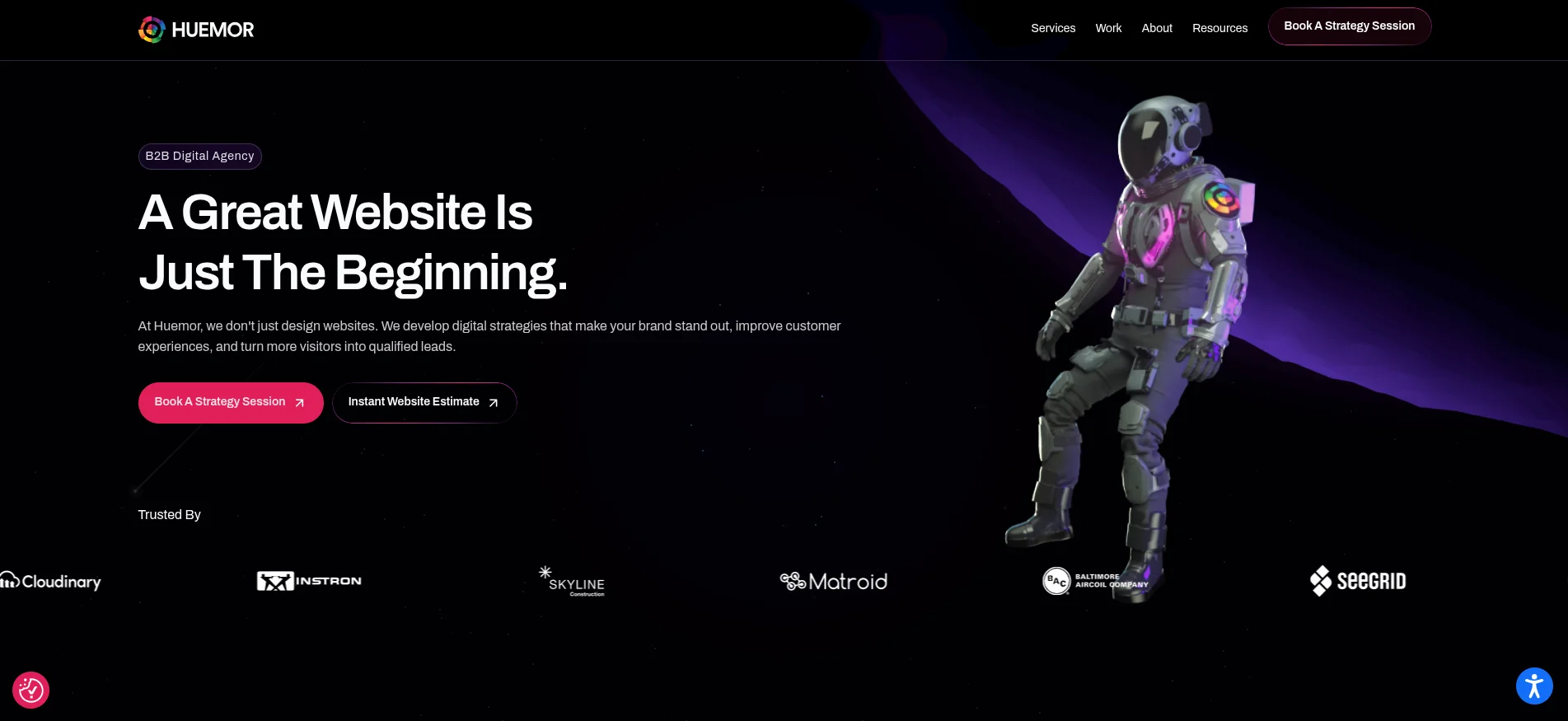
Huemor is a US web design agency mixing bold creative with measurable conversion lifts for B2B clients across multiple verticals.
Agency Overview
- Founded in 2011, serving B2B companies worldwide
- B2B verticals: SaaS, manufacturing, technology, construction, and professional services
- Won Clutch Best Website Design globally for HITT in 2025, plus Web Excellence Awards
- Known for helping companies improve visibility and capture right-fit customers through design and storytelling
Agency Approach To B2B Web Design
Huemor’s approach revolves around growth-driven design: continuing iterations post-launch based on analytics and user testing. They use storytelling, interactive elements, and trust markers while preserving clarity for busy buyers. Effective B2B websites support multiple buyer personas simultaneously, and Huemor designs for exactly that with strong UX discovery and persona-specific pathways.
Their common tech stack includes WordPress, custom front ends, and development solutions tailored to each client. CRO processes and conversion optimization are baked into the engagement, not bolted on.
Pros
- Strong visual differentiation that helps enhance user engagement
- Detailed discovery process with commitment to KPIs
- Experience across SaaS, manufacturing, and construction verticals
- Innovative design solutions that balance brand identity with conversion
Cons
- Heavier designs may require performance tuning for site speed
- Pricing above freelancer or small studio levels
- Less specialized in deep platform integrations compared to engineering-focused agencies
4. Webstacks
Best For B2B SaaS Marketing Sites On Modern Stacks
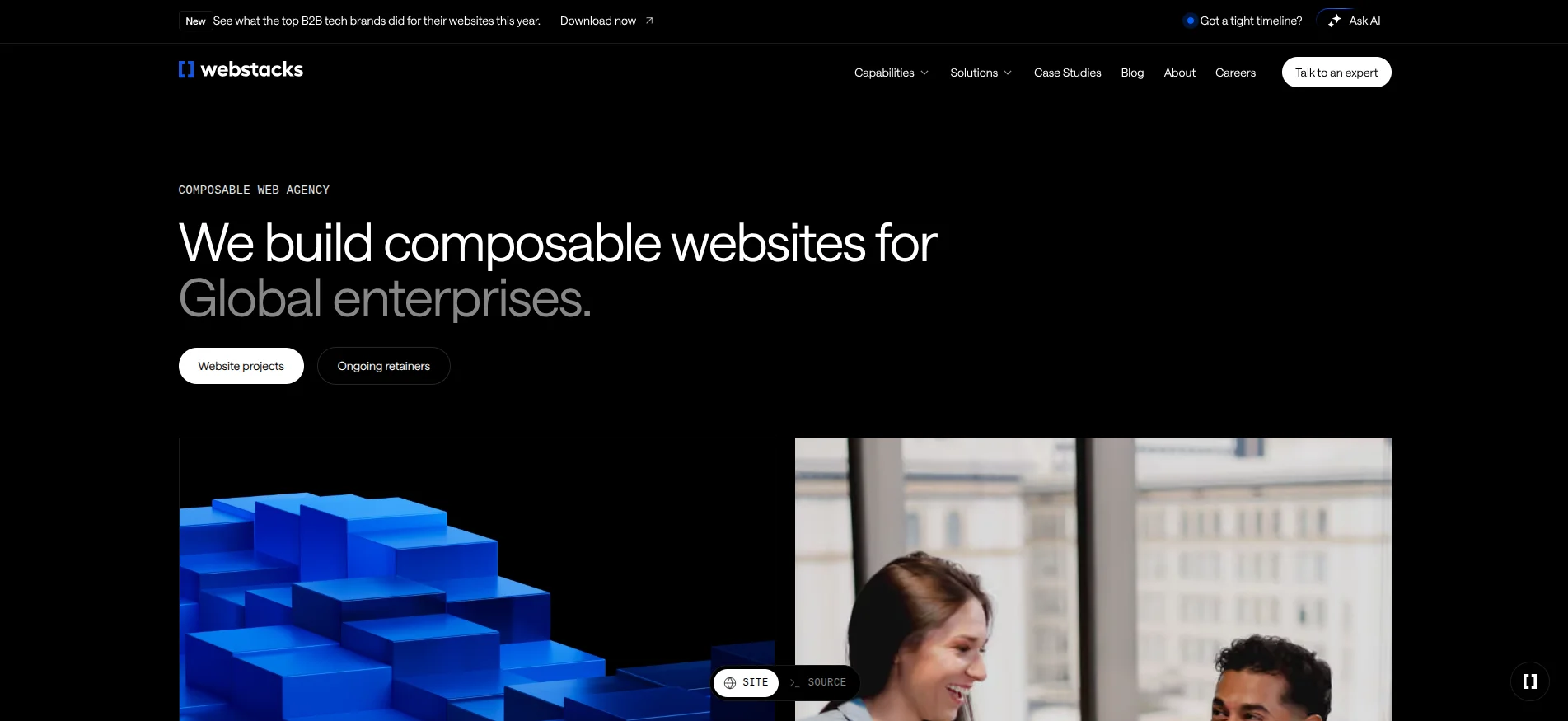
Webstacks is a composable web and CRO partner for fast-moving B2B SaaS teams that need a marketing site built for speed and continuous improvement.
Agency Overview
- Founded around 2019, based in San Diego
- Productized “website as a product” model for venture-backed SaaS, dev-tools, AI platforms, and cloud companies
- The ServiceTitan project involved migrating from HubSpot to headless CMS (Contentful) with React/Gatsby front end, launched in under 100 days
- Internal engineers reported 90% reduction in maintenance hours after Webstacks handoff
Agency Approach To B2B Web Design
Webstacks emphasizes Webflow, headless CMS, and Jamstack for performance and rapid iteration. They run sprint-based roadmaps with ongoing A/B testing and close collaboration with in-house marketing teams. Agencies should provide structured conversion rate optimization programs post-launch, and Webstacks delivers this through continuous experimentation cycles.
Integration expertise covers HubSpot, Salesforce, GA4, and Segment. Their development capabilities focus on empowering internal teams with documentation, component reusability, and reduced agency dependency. This makes them a strong development agency specializing in modern web development for technology companies.
Pros
- Speed of iteration with sprint-based delivery
- Strong developer experience and clean handoff documentation
- Ideal for continuous experimentation and digital experiences on modern stacks
- Empowers marketing teams to make content changes without engineering support
Cons
- Focused on marketing websites rather than deep transactional commerce or ERP work
- Visual brand expression may be secondary to performance optimization
- Less suited for non-SaaS industrial or manufacturing firms
- Budgets higher than very small boutiques
5. Clay
Best For Design-Led Enterprise B2B Experiences
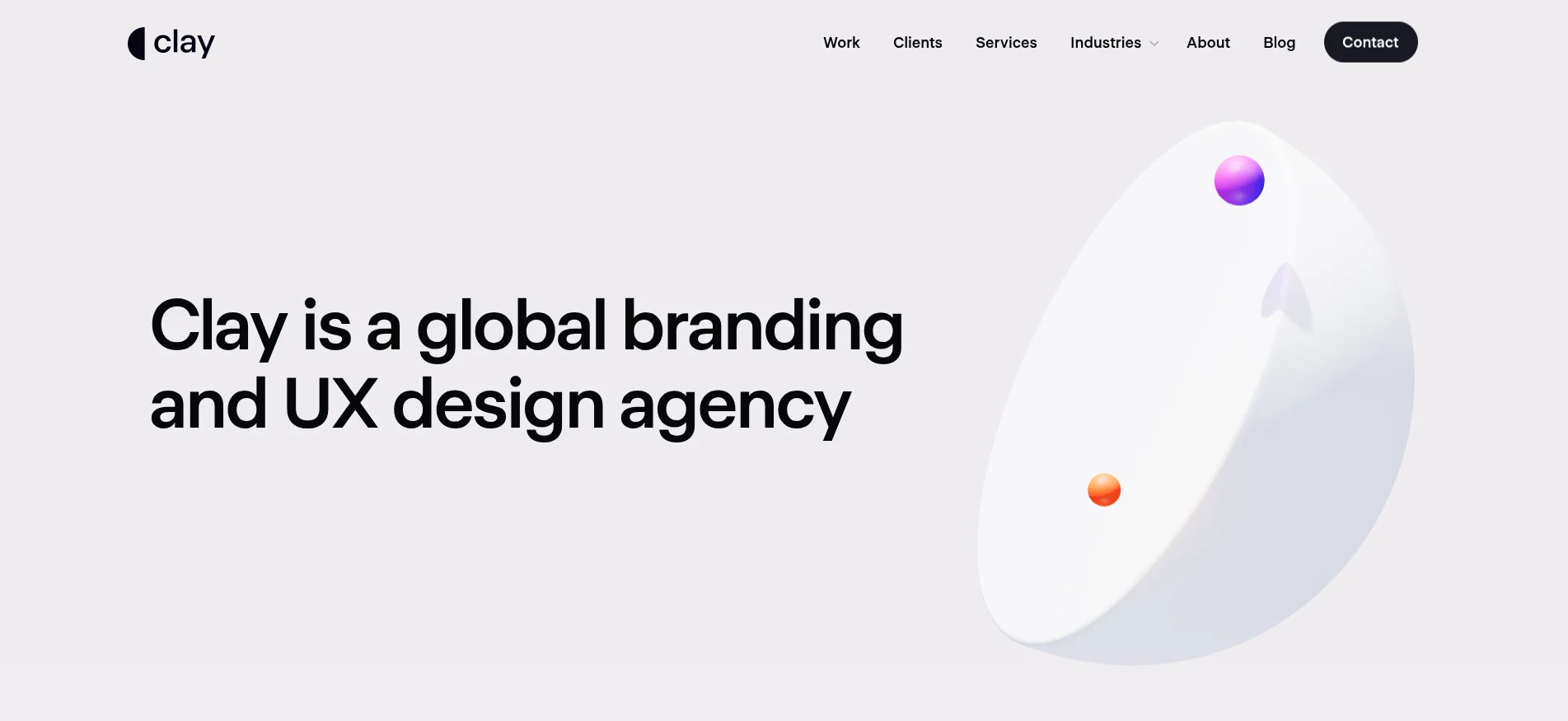
Clay has built a reputation for premium UI/UX and brand-driven corporate sites for tech and financial B2B brands that need their digital presence to match product sophistication.
Agency Overview
- Based in San Francisco, founded in 2009, team of 10 to 49
- Client roster includes enterprise tech and fintech brands, with roughly 70% enterprise, 20% mid-market clients
- Clutch rating of approximately 4.8 out of 5
- Minimum project size of $50,000+, hourly rates of $150 to $199
Agency Approach To B2B Web Design
Clay’s research-heavy process includes stakeholder interviews, user research, design systems, and prototypes. They focus on sophisticated interactions and polished UI systems that reflect complex digital products simply. Their user centric design philosophy covers both marketing site and product UI alignment.
Their service mix spans roughly 30% UX/UI design, 30% web design, 20% branding, and 10% low-code development. Platforms include custom front ends, Webflow, and enterprise CMS. They create memorable digital experiences through scalable design systems and innovative solutions.
Pros
- World-class visual design and brand strategy for enterprise clients
- Strong for flagship corporate and product marketing sites
- Scalable design systems that serve both marketing and product teams
- Deep experience in fintech and regulated industries
Cons
- $50,000+ minimum excludes smaller firms and lean budgets
- Timelines suited to large initiatives rather than quick launches
- Less focused on mid-market or basic lead-gen sites
- More about design and brand expression than full-funnel demand generation
6. Lform Design
Best For Industrial & Manufacturing B2B Websites
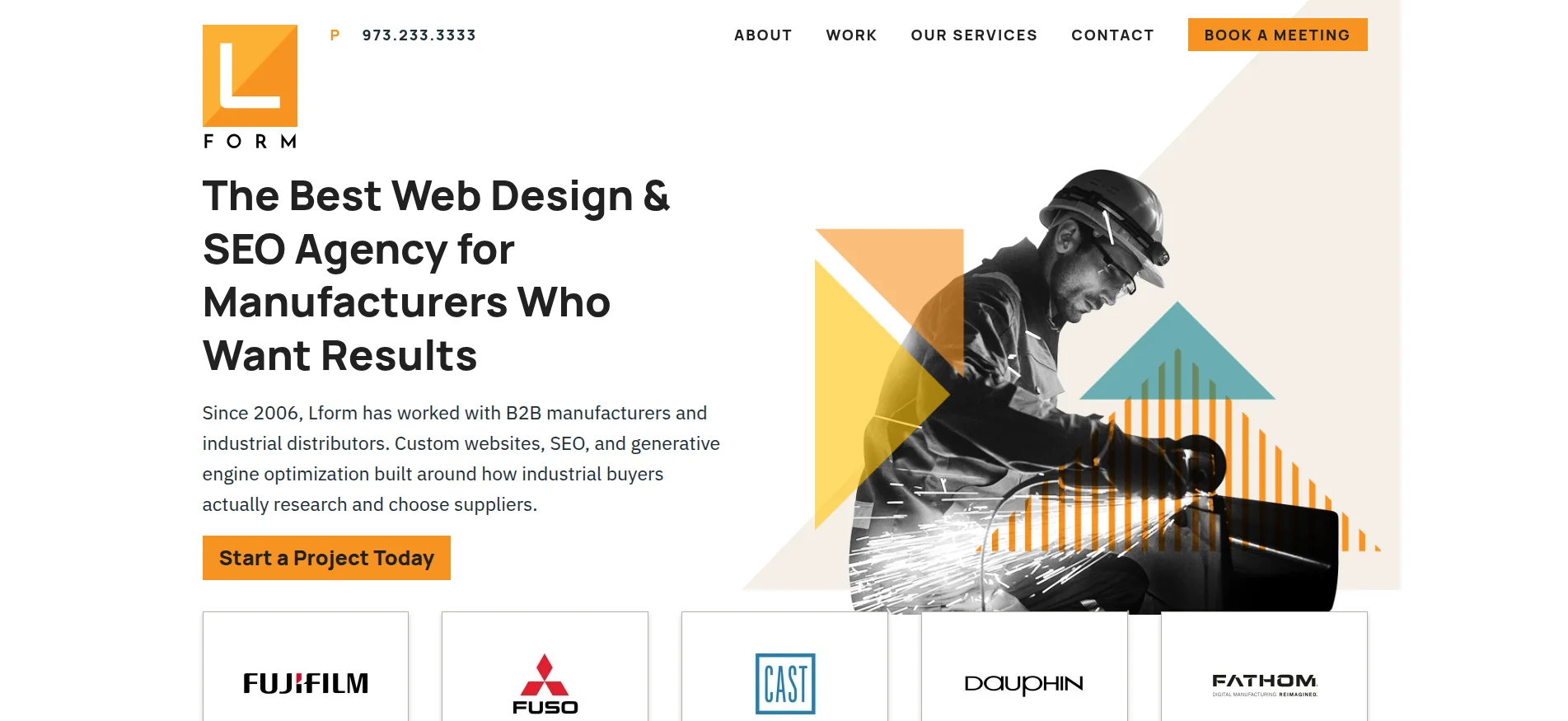
Lform Design is a boutique New Jersey website design agency specialized in industrial and technical B2B brands that need complex product hierarchies presented clearly.
Agency Overview
- Founded in the mid-2000s with a small senior team model
- Focus on US manufacturing, engineering, and distribution companies
- Clients include OEMs, component manufacturers, and industrial service providers
- Case studies show increased RFQs and better distributor engagement after launch
Agency Approach To B2B Web Design
B2B websites often require complex information architecture for long sales cycles, and Lform excels at building this for industrial catalogs. They emphasize technical content clarity, rich product catalogs, and resource libraries. B2B web design projects often require complex information architecture, which is their core strength.
Their SEO-first builds run on WordPress or other CMS platforms, with attention to site speed and site architecture. They handle large product hierarchies and integrate with basic portals or catalog tools. Their professional web design work reflects deep expertise in industrial verticals.
Pros
- Deep industrial experience with strong information architecture for complex catalogs
- Close owner-level attention and efficient project management
- Understands technical buyer needs for datasheets, certifications, and specifications
- SEO-first approach that drives organic traffic for niche industrial terms
Cons
- Less suited for global enterprise transformations or consumer brands
- Limited capacity for dozens of parallel projects
- Visual design may lean functional over trendy
- Not the pick for SaaS or enterprise software marketing sites
7. Ironpaper
Best For B2B Demand Generation & ABM-Focused Sites
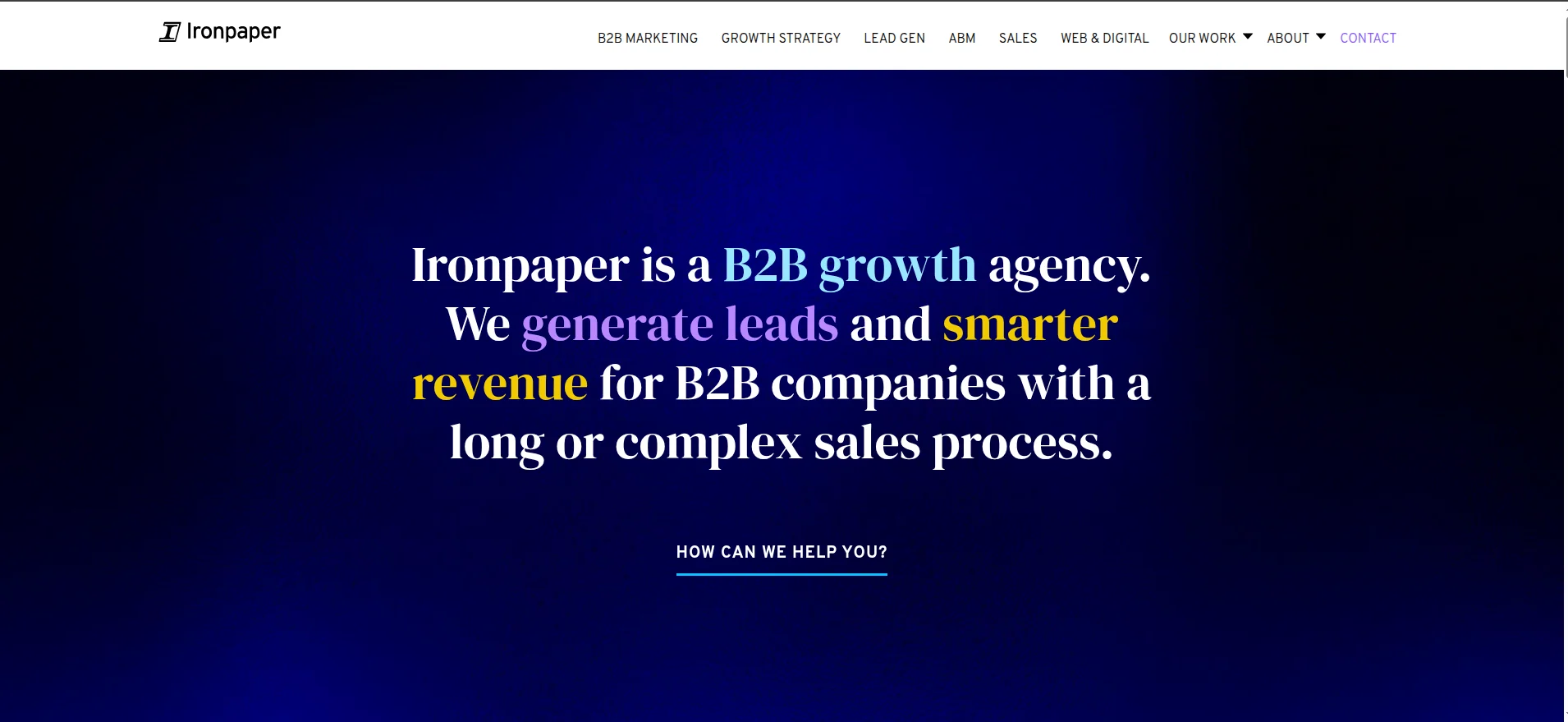
Ironpaper is a growth marketing agency where the website is part of a broader demand-gen machine, not a standalone project.
Agency Overview
- Founded in the early 2000s, with presence in New York and Charlotte
- Specializes in B2B tech/IT with retainer models combining web, content, and campaigns
- Portfolio results include 3000% lead generation increase and tripled deal values for select clients
- Works with mid-market to enterprise clients on comprehensive services spanning web, content marketing, and digital marketing
Agency Approach To B2B Web Design
Ironpaper treats the website as the hub of a full-funnel program covering ABM, paid, SEO, and content offers. B2B web design should integrate clear calls to action for lead generation, and Ironpaper builds every page around this principle. They use persona research, messaging frameworks, and conversion path design.
Platforms include HubSpot CMS and WordPress, with strong analytics and reporting practices. Their development services and marketing services blend into tailored solutions for companies wanting one partner for web plus ongoing demand-gen support.
Pros
- Measurable pipeline focus with strong ROI evidence
- Good for companies wanting one partner for web plus ongoing support
- Deep understanding of B2B sales cycles and ABM strategies
- Strong analytics and reporting that connect website to revenue
Cons
- Less suited for pure design-only engagements
- Minimum engagement sizes may exclude very small firms
- Retainer model requires ongoing investment commitment
- Design aesthetic may be secondary to performance and conversion goals
8. UPQODE
Best For Design-Forward B2B Sites On A Moderate Budget
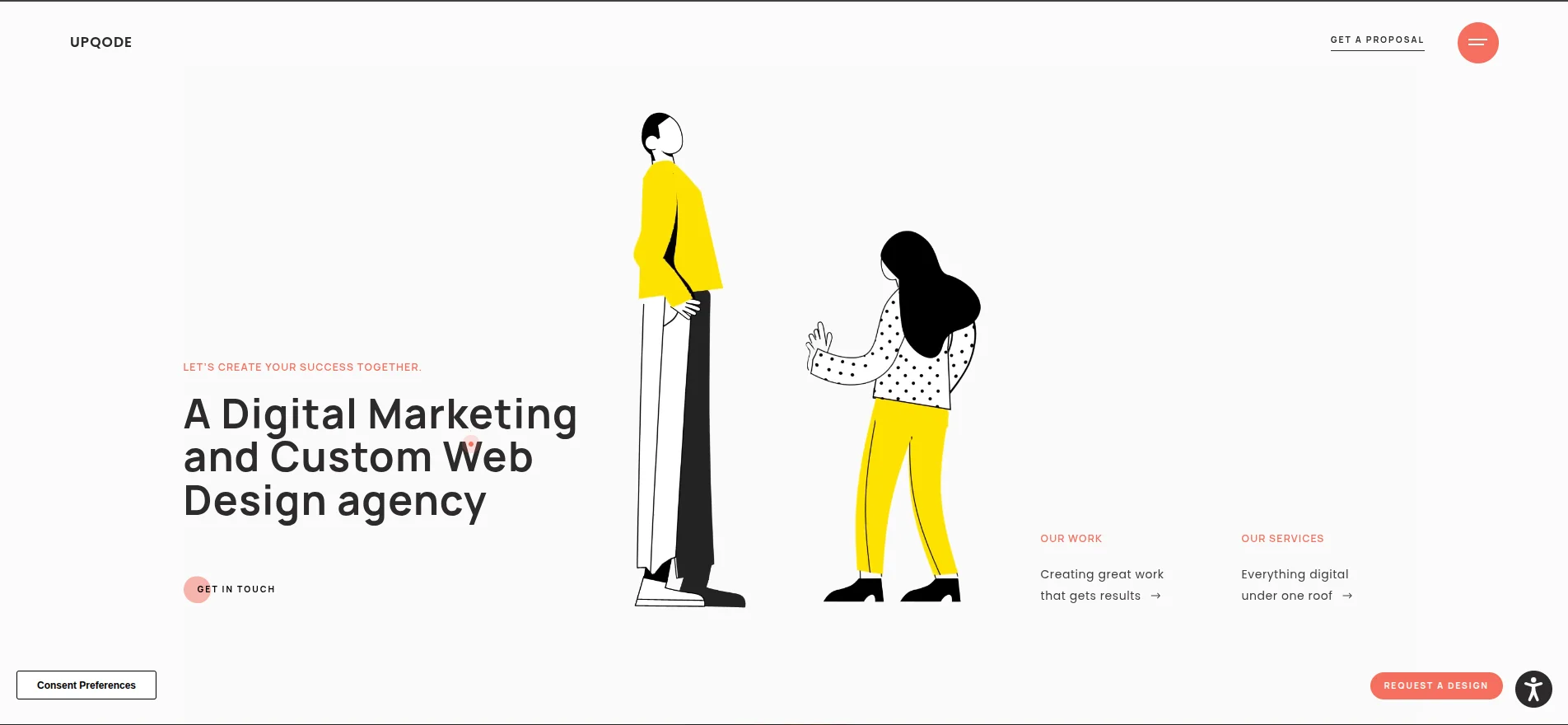
UPQODE is an award-winning web design company balancing aesthetics and performance for B2B firms that need quality design services without enterprise pricing.
Agency Overview
- Founded in 2015, headquartered in Nashville with European offices
- Mid-sized distributed team serving B2B SaaS, logistics, IT services, and agencies
- Award history across multiple web design categories
- Recent projects show improved user engagement and time on site for B2B clients
Agency Approach To B2B Web Design
UPQODE focuses on clean layouts, performance, and mobile-first implementation on WordPress, Webflow, or Shopify. They use conversion tracking, on-page SEO, and structured content to support lead generation. Their web designers deliver full service web design through flexible models (project-based or ongoing support) that appeal to growing B2B companies seeking website development without long-term lock-in.
Pros
- Strong design-to-price ratio among top web design agencies
- Transparent process with clear milestones
- Quick turnaround compared to big consultancies
- Flexible engagement models for growing companies
Cons
- Not focused on ultra-complex ERP or commerce builds
- Some clients may outgrow standard packages as needs scale
- Less deep in ABM or demand-generation strategy
- Limited case studies in highly regulated industries
9. Phenomenon Studio
Best For Product-Led B2B & SaaS Experiences
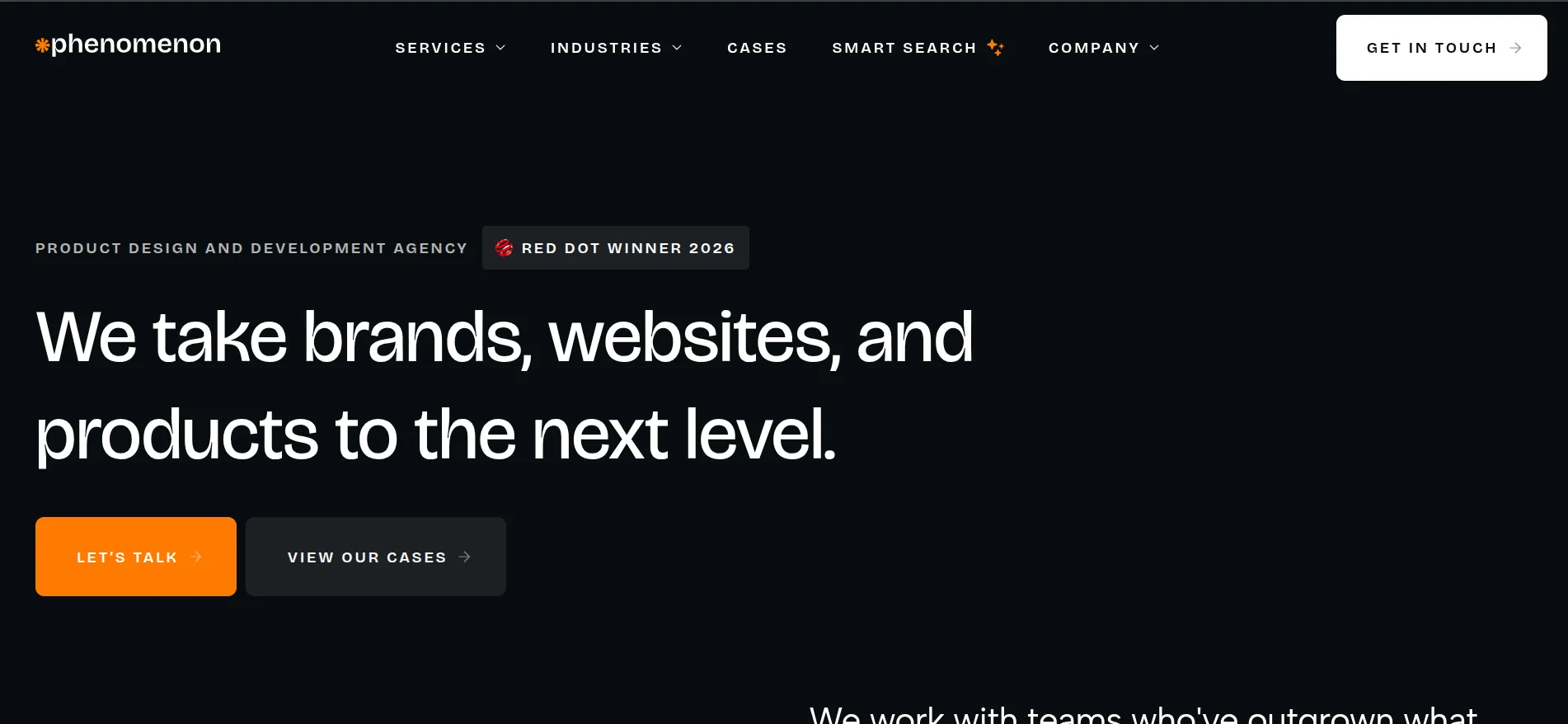
Phenomenon Studio is a European-rooted, product-focused shop that pairs apps and marketing sites through consistent design systems and deep UX research.
Agency Overview
- Offices in Ukraine, Estonia, Poland, and Switzerland, with remote US/UK presence
- Full-cycle design agencies covering SaaS, fintech, AI tools, and B2B platforms
- Focus on unified product and marketing design for digital products
- Design recognition in 2024 and 2025 for governance and analytics platform UX work
Agency Approach To B2B Web Design
Phenomenon Studio connects marketing sites, dashboards, and portals via consistent design systems. Their UX research, prototyping, and usability testing routines address complex workflows where the marketing site must mirror in-product UX. Development stack includes React, Next.js, Webflow, and headless CMS with cross-functional teams delivering creative development and development solutions across time zones.
Pros
- Strong when marketing site must align with product UX and visual identity
- Cost-effective senior talent compared to US-only agencies
- Flexible engagement models for social media management and web builds
- Deep understanding of SaaS and fintech buyer behavior
Cons
- Time zone considerations for US-only teams needing real-time collaboration
- Less suited for traditional industrial firms needing local presence
- Smaller brand recognition in the US market
- Less focused on content-heavy marketing sites
10. Lounge Lizard
Best For Full-Service B2B Web & Digital Marketing
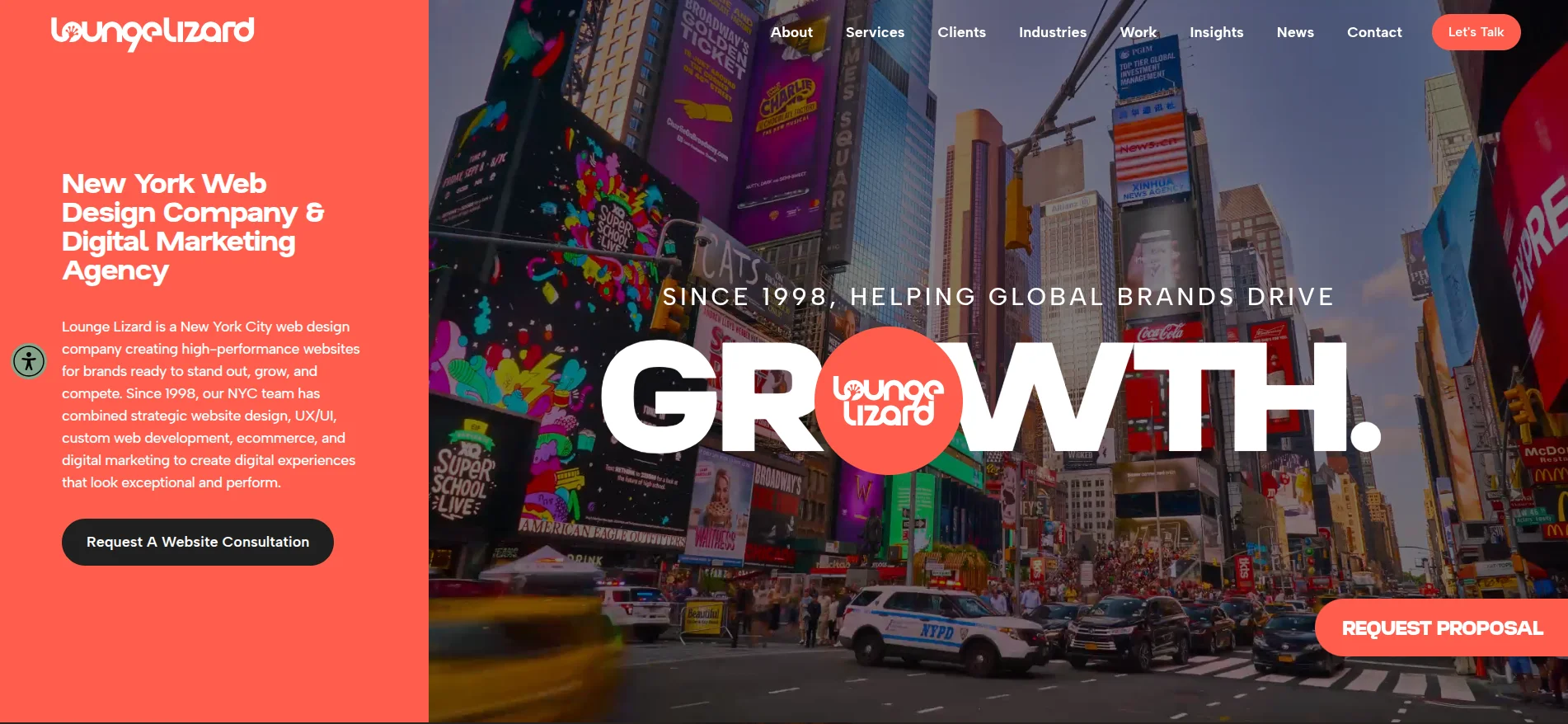
Lounge Lizard brings a long history as a US development company blending web, branding, and digital marketing for B2B organizations that want comprehensive digital strategies under one roof.
Agency Overview
- Founded in the late 1990s, with offices in New York, Los Angeles, and Long Island
- Broad client base spanning professional services, manufacturing, biotech, and technology
- Recent redesigns (2023 through 2025) combined new branding with measurable increases in inbound opportunities
- Agencies must offer analytics and quick change requests after launch, and Lounge Lizard builds this into their retainer model
Agency Approach To B2B Web Design
Lounge Lizard’s combined branding plus web plus digital marketing model works well for companies rethinking their brand identity and positioning simultaneously. Platforms include WordPress, HubSpot, and Adobe Commerce. Their process covers content strategy, UX wireframes, and post-launch optimization alongside social media management and comprehensive services.
Pros
- One-stop shop for web design services, branding, and marketing services
- Long track record with enterprise brands and mid-market firms
- Can manage complex redesigns involving brand strategy overhaul
- Broad technical expertise across multiple CMS platforms
Cons
- May be more than needed for focused, single-product SaaS sites
- Pricing reflects full-service scope
- Agency breadth can mean less specialization in any single vertical
- Larger team structure may slow decision cycles
Who Each Agency Is Best For
This comparison table helps you quickly match web design agencies to your situation.
| Agency | Best For | Typical Client Size | Core Platforms | Region Focus |
| 310 Interactive | Mid-Market B2B lead generation | Large enterprise | HubSpot CMS, WordPress | US |
| Bop Design | SMB & Mid-market | SMB to mid-market | WordPress | US |
| Huemor | B2B brand + conversion | Mid-market to enterprise | WordPress, custom | US, global |
| Webstacks | SaaS scale-ups, modern stacks | SaaS mid-market | Headless CMS, Webflow, React | US |
| Clay | Design-led enterprise | Enterprise | Custom, Webflow, AEM | US, global |
| Lform Design | Industrial & manufacturing | Industrial SMEs | WordPress | US |
| Ironpaper | Demand gen & ABM | Mid-market to enterprise | HubSpot CMS, WordPress | US |
| UPQODE | Design-forward, moderate budget | Growing B2B | WordPress, Webflow | US, Europe |
| Phenomenon Studio | Product-led SaaS & fintech | SaaS, fintech | React, Next.js, Webflow | Europe, US |
| Lounge Lizard | Full-service web + marketing | Mid-market to enterprise | WordPress, HubSpot, Adobe | US |
Agencies focused on SaaS (Webstacks, Phenomenon Studio, Clay) prioritize modern tech stacks and rapid iteration. Industrial-focused agencies (Lform, Bop Design) prioritize content depth and catalog navigation. Full-service shops (Ironpaper, Lounge Lizard, 310 Interactive) wrap web design into broader marketing and demand-gen programs.
Budget & Timeline At A Glance
Here is a quick way to understand rough investment and pace expectations for a B2B web design project in 2026.
| Agency | Minimum Project Budget (USD) | Typical Range | Average Timeline for New B2B Site |
| 310 Interactive | $20,000 | $100k to $500k+ | 16 to 30+ weeks |
| Bop Design | $25,000 | $25k to $75k | 10 to 16 weeks |
| Huemor | $50,000 | $50k to $150k | 12 to 20 weeks |
| Webstacks | $50,000 | $50k to $200k | 12 to 16 weeks |
| Clay | $50,000 | $50k to $250k+ | 14 to 24 weeks |
| Lform Design | $20,000 | $20k to $60k | 8 to 14 weeks |
| Ironpaper | $40,000 | $40k to $120k (retainer) | 12 to 20 weeks |
| UPQODE | $15,000 | $15k to $50k | 8 to 12 weeks |
| Phenomenon Studio | $25,000 | $25k to $100k | 10 to 18 weeks |
| Lounge Lizard | $30,000 | $30k to $100k | 10 to 16 weeks |
Budget considerations influence the choice of B2B web design agency significantly. These figures are indicative based on public data and may change with scope, integrations, and content readiness. Complex multi-language or ERP-integrated projects will push toward the higher end.
Key Factors To Consider Before Hiring A B2B Web Design Agency
The best b2b web design agency for your company depends on your business objectives, tech stack, and internal capabilities. B2B websites often serve multiple stakeholders with different needs, so getting the fit right matters more than picking the most well-known name.
Here are the core factors to evaluate:
- Business objectives: What the site must accomplish (leads, demos, credibility, self-service)
- Industry fit: Whether the agency has proven experience in your vertical
- Technical requirements: CRM, MAP, ERP, and CMS integration needs
- Internal resources: Who will own content, approvals, and ongoing site management
- Long-term roadmap: Whether you need a one-time build or an ongoing partner
Factor 1: Your Primary Business Goal For The Website
There is a big difference between a lead-generation site, a product marketing site, and a transactional portal. A company focused on demo requests might choose Ironpaper or Webstacks, while a manufacturer prioritizing RFQs might consider Lform or Bop Design.
B2B buyers require friction-free paths to pricing, demos, and gated technical documents. If your goal is filling the pipeline, the agency must excel at conversion architecture. If your goal is brand credibility for a fundraising round, a design-led agency like Clay or Huemor is a stronger fit. Map your primary goal first, then match agencies to it.
Factor 2: Industry & Buyer Complexity
Regulated or highly technical industries (healthcare, fintech, industrial equipment) benefit from agencies with proven vertical experience. Agencies should demonstrate expertise in your specific industry and showcase relevant case studies in the same industry.
B2B web design requires multi-persona navigation for diverse stakeholders. A cybersecurity firm needs deep content and trust elements, while a logistics SaaS needs self-serve demos. Failing to map the buyer journey leads to poor site navigation, which kills conversion rates. Map your decision-makers and buying stages, then check agency portfolios for similar journeys.
Factor 3: Platform, Integrations & IT Constraints
Your existing CRM, MAP, or ERP systems may dictate platform choice. Consider the agency’s expertise in CMS integration and handling complex buyer journeys before you brief anyone. Inventory must-have integrations like Salesforce, HubSpot, SAP, NetSuite, or custom APIs.
Webstacks is comfortable with headless CMS and Jamstack. Ironpaper works heavily through HubSpot. 310 Interactive handles enterprise CMS and complex multi-system architectures. Matching your tech stack to agency strengths avoids painful mid-project surprises.
Factor 4: Content, SEO & Localization Needs
Content volume (blogs, resources, documentation) and language/localization requirements are major scope drivers. Ignoring the importance of content strategy can weaken messaging and undermine even the best design work.
Agencies with strong content and SEO programs (Bop Design, Ironpaper, Lounge Lizard) are better fits when you need extensive content creation alongside design. If you are migrating from an old CMS, insist on SEO-safe migration practices to protect your existing organic traffic.
Factor 5: Budget, Timeline & Internal Team Capacity
Use the budget and timeline table above to set realistic expectations before outreach. Agencies should provide clear line-item pricing for services so you can compare apples to apples. Not asking for post-launch metrics indicates a lack of accountability, so make that a qualifying question in every discovery call.
There are real trade-offs between large, high-craft agencies and lean boutiques. A $20k project at Lform delivers a different outcome than a $200k engagement with 310 Interactive, but both can be the right choice depending on your situation. Assess your internal capacity honestly: who will write content, approve designs, and manage the site after launch?
Typical B2B Web Design Project Milestones
This table shows what a 12 to 20 week B2B web project typically includes.
| Phase | Main Activities | Typical Duration (Weeks) |
| Discovery & Strategy | Stakeholder interviews, buyer persona mapping, competitor audit, analytics baseline | 2 to 3 |
| Information Architecture & Wireframing | Sitemap, navigation logic, templates, UI wireframes, user flows | 2 to 4 |
| Visual Design & Branding | Mockups, style guide, design system, visual treatments | 2 to 3 |
| Development & Integrations | Front-end/back-end build, CMS setup, APIs (CRM, MAP), responsive/mobile | 3 to 5 |
| Content Creation & Migration | Writing buyer-oriented content, migrating existing content, optimizing assets | 2 to 4 |
| QA, Testing & Launch | Performance tests, cross-device/browser testing, SEO migration checks, accessibility | 1 to 2 |
| Post-Launch Optimization | Monitoring, bug fixes, CRO/A/B test roadmap, analytics setup | 2 to 4 |
Complex integrations (ERP, multi-system APIs) can add 3 to 6 weeks to the development phase- Multilingual or localized sites often double the content creation timeline
- Delays most frequently stem from content not being ready or slow internal approvals
Common B2B Website KPIs To Track Post-Launch
Post-launch measurement is crucial for optimizing B2B web design success. Here are the KPIs that matter most.
| KPI | What It Measures | Typical B2B Benchmark Range |
| Organic Traffic Growth | SEO + content improvements pulling relevant visitors | +30 to 100% in 6 to 12 months |
| Demo/Quote Request Conversion Rate | Percentage of visitors submitting demo, RFQ, or quote forms | 1 to 5% for targeted mid-market traffic |
| Marketing Qualified Leads (MQLs) | Leads meeting defined qualification criteria | 50 to 200% year-over-year growth |
| Time on Key Pages / Bounce Rate | Content engagement and relevance | Bounce rate below 60%; 2+ min on resource pages |
| Time-to-Launch | Kickoff to go-live | 8 to 12 weeks (simple); 12 to 20+ weeks (complex) |
| Pipeline Influence | Revenue traceable to website or content efforts | Varies widely; strong agencies report 400 to 500% pipeline increase |
Post-launch measurement tracks marketing qualified lead volume and organic traffic as leading indicators. It also tracks lead volume and conversion rates to connect website performance to revenue. Agencies should prioritize post-launch measurement and optimization as part of every engagement. Choose partners who can instrument and report on these KPIs from day one.
Which B2B Web Design Agency Is Best For You?
There is no single winner. Choosing a B2B web design agency depends on industry, tech stack, and goals. Here is a quick decision guide:
- Choose 310 Interactive if you need an enterprise-grade, custom B2B site with complex requirements and multi-region reach
- Choose Bop Design or Lform Design if you are a mid-market industrial or professional services firm focused on leads and RFQs
- Choose Webstacks or Phenomenon Studio if you are a B2B SaaS company needing a modern, product-led marketing site
- Choose Clay or Huemor if brand expression and high-end design are critical differentiators for your digital presence
- Choose Ironpaper or Lounge Lizard if you want web plus ongoing marketing and demand-gen support from a single marketing agency
Shortlist 2 to 3 agencies and run structured discovery calls comparing process, fit, and evidence. Ask for case studies in your industry, detailed scoping documents, and references from comparable B2B clients.
Final Thoughts
Your B2B website is a primary sales asset, not a digital brochure. Continuous website evolution is essential because sites are never truly finished. The best web design companies understand this and build for iteration, not just launch day.
As AI-assisted buying continues reshaping how prospects research vendors, technically strong, content-rich B2B sites will separate winners from the rest. Prioritize agencies that offer clarity on scope, ownership, and post-launch optimization rather than just visual redesigns. Align your agency choice with buyer journey, tech stack, and revenue goals.
The right partner will treat your website as a revenue engine. The wrong one will hand you a pretty brochure and disappear.
FAQs About Hiring A B2B Web Design Agency
These FAQs address common concerns before signing an agency contract.
How much does a B2B web design project typically cost in 2026?
- Smaller B2B sites start around $15,000 to $25,000 for focused marketing sites
- Mid-market projects with content strategy and integrations run $40,000 to $100,000
- Enterprise builds with localization, heavy integrations, and custom development reach $100,000+
- Cost drivers include scope, integrations, content creation volume, localization, and agency tier
How long will my B2B website redesign take?
- Focused marketing sites with minimal integrations: 8 to 12 weeks
- Complex, integrated platforms with multi-persona navigation: 4 to 9 months
- Key dependencies: content readiness, internal approval speed, and integration complexity
- Agencies that run sprint-based processes (like Webstacks) tend to deliver faster for SaaS sites
What should be included in a B2B web design RFP or brief?
- Business goals and target segments
- Current site metrics and analytics access
- Tech stack inventory (CRM, MAP, CMS, ERP)
- Content inventory and SEO baseline
- Budget range and timeline expectations
- 2 to 3 example sites you admire and why
How do I evaluate an agency’s B2B experience?
- Check for named B2B case studies with quantitative metrics (lead uplift, traffic growth, conversion improvement)
- Look for industry overlap and experience with multi-stakeholder journeys
- Ask for specific examples of improved conversion, SEO performance, or sales cycle acceleration
- Agencies should demonstrate expertise in your specific vertical, not just “B2B” broadly
Should I choose a local agency or a remote one?
- Local agencies offer time zone alignment and in-person workshops for complex discovery
- Remote agencies provide access to specialized talent and often better value
- Process, communication cadence, and evidence of results matter more than proximity alone
- Many of the best b2b web design agencies on this list serve clients nationwide or globally
What’s the difference between a B2B web design agency and a generic web studio?
- B2B specialists design for long sales cycles, multiple personas, and integration with CRM and ABM tools
- Generic studios may focus purely on aesthetics or simple ecommerce flows without understanding complex buyer behavior
- A B2B web design agency will prioritize conversion architecture, content strategy, and post-launch measurement
- Look for agencies that speak your language: pipeline, MQLs, buyer journey, and revenue influence